A new species of Hisonotus (Siluriformes, Loricariidae) from rio São Francisco basin, Brazil
Fábio Roxo, Gabriel da Costa e Silva, Claudio Oliveira
ZooKeys 498: 127-143 (21 Apr 2015)
Abstract
A new species of
Hisonotus is described from the rio São Francisco basin. The new species can be distinguished from congeners by having
(1) a unique coloration pattern of caudal fin with one black spot extending from its origin to the ventral lobe and two dark spots at the end of the lobe’s rays;
(2) odontodes forming longitudinally aligned rows on head and trunk;
(3) a functional
V-shaped spinelet;
(4) a single rostral plate at the tip of the snout;
(5) by lacking contrasting dark geometric spots on the anterodorsal region of the body;
(6) a lower caudal-peduncle depth; and
(7) lower counts of the lateral median plates and
(8) higher premaxillary and dentary teeth.
The new species is the second described species of the genus
Hisonotus in the rio São Francisco basin. It was found inhabiting the marginal vegetation of the rio São Francisco and three of its tributary, rio das Velhas, rio Paraopeba and rio Formoso.
Die neue Art heisst
Hisonotus vespuccii, benannt nach Américo Vespúcio, der den Rio São Francisco im Jahr 1501 entdeckt haben soll. Neben
Hisonotus bocaiuva ist es die zweite
Hisonotus-Art aus dem Fluss-System.
Link zum Paper
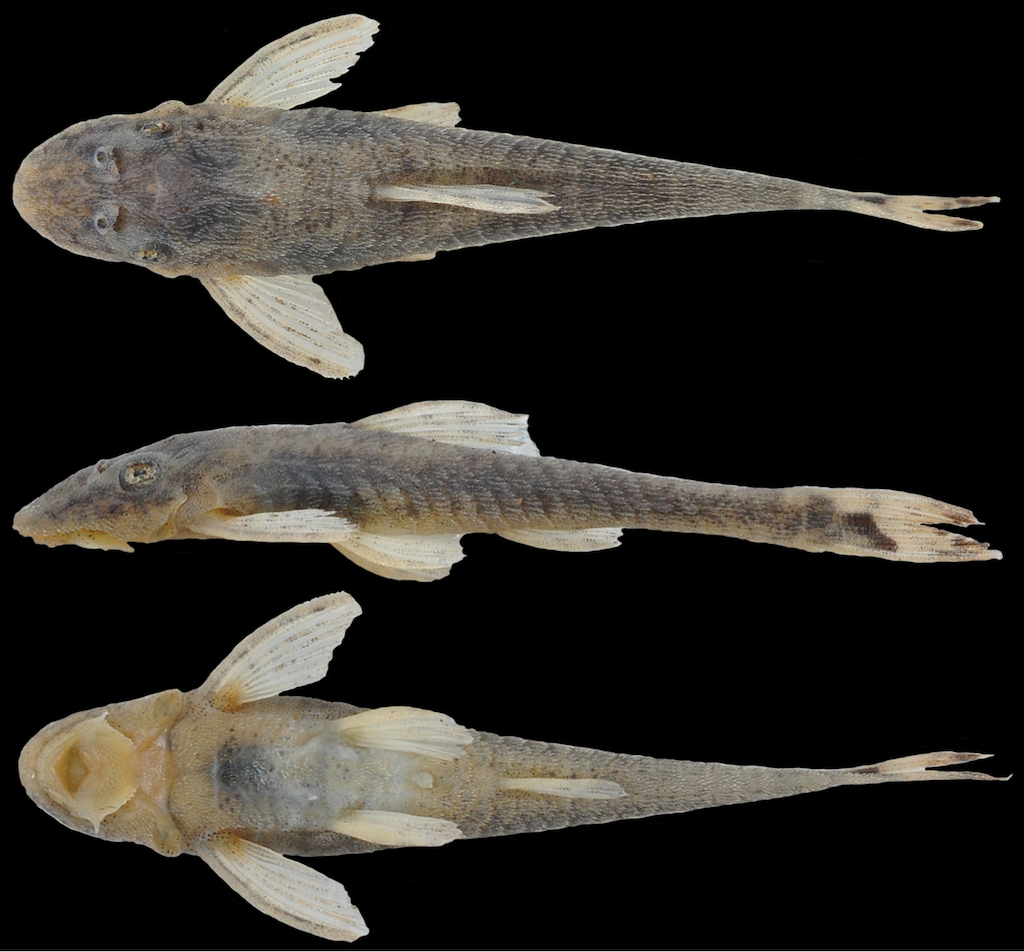
Holotype of
H. vespuccii, MZUSP 115274, female, 32.6 mm SL, from Minas Gerais State, municipality of Pirapora, rio São Francisco, 17°21'00"S, 44°57'08"W (Mit freundlicher Genehmigung Pensoft Journals, veröffentlicht unter der
Creative Commons Attribution License (CC BY 4.0))
Gruß,
Karsten